

Ruska – autumn Finnish style
When you think of Finnish Lapland, you picture winter landscapes. But did you know that this part of Finland above the Arctic Circle is also worth a visit in autumn? Then it's...narrow, or autumn, but Finnish-style. With explosions of color on the land and in the sky. In autumn, the aurora and ruska come together in the far north of Europe.
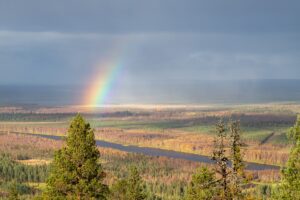
During ruska (autumn), not only the land but also the sky changes color.
We had been to Finnish Lapland before. In the WinterThen, Europe at and above the Arctic Circle becomes an endless white landscape with snow-capped treetops. A white blanket in a dark world, because the sun barely rises above the horizon during the winter months. A world unknown to people elsewhere in the world. And precisely for that reason, it holds a magical allure for visitors who venture out here with huskies, reindeer, or snowmobiles.
Come back during ruska
In winter, you can also go skiing, cross-country skiing, and snowshoeing in Finnish Lapland. With the added bonus of a night filled with the Northern Lights spectacle. If you're lucky, of course. We weren't. Clouds and snow showers made the darkness of Finnish Lapland even darker, and the aurora borealis didn't show up. "A good reason to come back," we were told then. "Then come during the ruska', they added. And we did!
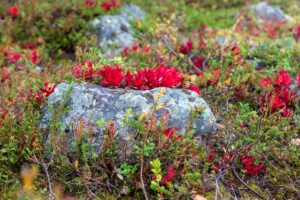
We've returned to the far north of Europe. In autumn, without snow. We quickly discover what the Finns mean by ruska. It's more than just faded trees and bushes covered in colorful berries. It's also the realization that there's still light. Still. Because every day, the sun shows itself 15 minutes less. Winter and the darkness that comes with it are rumbling closer.
Before winter arrives, the Finns enjoy. The light. The colors. The smells. The harvest. The peace. That is ruska.
After the ruska comes winter, and with it the tourists. It's therefore also the time to prepare for winter. That's the peak season for tourism.
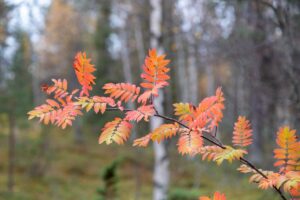
Lichen for the reindeer
In a green field, bordered by white birches with yellow leaves and tall pines, Juho feeds a few of his reindeer with freshly picked lichen in the late autumn sun. His family has been raising these herd animals near Rovaniemi for four hundred years. Primarily for meat, but because that alone is no longer enough to make ends meet, the four-legged animals are used to ferry tourists around in the winter. In the summer, the reindeer roam freely. In the fall, the animals are slowly but surely brought back to the Sieriporo farm.
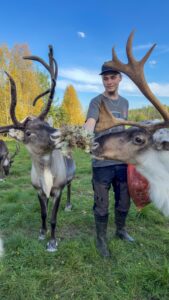
Juho and his reindeer. Lichen is a treat for these animals.
Thanks to GPS in a collar, Juho can track his animals precisely. Otherwise, he recognizes them by the special "tag" in their ears. Every reindeer herder has their own ear tag, and Juho received his when he was a few months old, just like his father, grandfather, and ancestors. He got his first reindeer as a child. "I always dreamed of keeping reindeer like my father and grandfather. I've made that dream come true," says the 19-year-old Finn.
Dying craft: reindeer herding
He's one of the few young people following in his parents' footsteps. "The life of a reindeer herder is wonderful, but hard. Not everyone is up for it. The profession and craft are slowly dying out because of it. But I love it; it's my life's purpose." Some of his reindeer are being trained for a career in tourism. "They're semi-wild animals, so you don't just put them in front of a sleigh. We spend about five years preparing a reindeer through a systematic process," Juho explains.
Meanwhile, numerous reindeer mill around him, their ankles clicking. "The clicking is a way of communicating within the herd," Juho explains. "Quick click-clacks signal danger. Then they have to run. The forests are also home to bears, wolves, and wolverines, the reindeer's natural enemies." While the animals calmly click-clack their way through the lichen, we say goodbye to Juho and head to other animals preparing for winter: huskies.
Ruska: training season for huskies
Betty Maly is the manager of the Bearhill Husky Tours, hidden deep in the forests near Rovaniemi. “Normally we would have been training and preparing with the dogs for a long time, but it was much too hot last summer and now, during the ruska"The temperature is still too high for these dogs," she says. "Their welfare is our top priority, so we're not going to do anything that's not good for them."
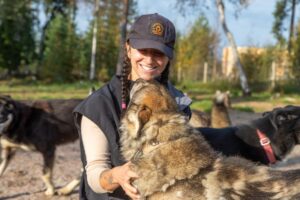
Betty Maly of Bearhill Husky Tours, a company with a green certification.
Soon, weather permitting, the huskies will be back in full training mode, ready for the winter sled rides, safaris, and expeditions with tourists. In the meantime, they can enjoy themselves daily in the off-leash area or go on walks through the woods with their handlers. "It's not only fun and educational, but also important that the dogs stay active and can burn off their energy."
Book a green husky tour
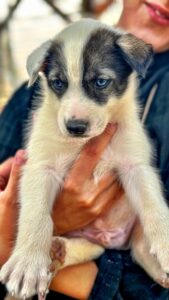
The Bearhill Husky Kennel has several "green" certifications, such as Green Activities and Sustainable Travel Finland. This is important, says Betty: "If you book a husky tour with a company with these labels, you might pay a little more, but then you, as a consumer, know that they operate sustainably and with animal-friendly practices. The dogs are well cared for, have good housing, and are treated with love." We see this as we tour the grounds. A highlight is a visit to the maternity ward, where the puppies happily hop around and are welcome to be cuddled. It's also nice to hear that huskies are rehomed to private individuals after their "retirement" so they can enjoy a happy old age.
Hugging trees in the Ruska season
The next day, we drive through the colorful forests of Rovaniemi to the Levi ski resort, located some 200 kilometers north of the Arctic Circle. We visit a Dutchman who has lost his heart and soul to Finnish Lapland.
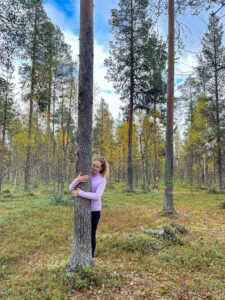
About eighteen years ago, Steffan Wunderink settled in Sirkka, near Levi, where his Finnish wife Riitta is from. In 2015, they founded Hello Tree Op, a family business where the forest, which has been in Riitta's family for generations, takes center stage. "We show tourists how beautiful, fragile, and important this green lung of Finland is. At the same time, we want to make money, and we do that by organizing all kinds of activities, from tree hugging to 'Arctic cocooning.'"
Campfire Barista in Finland
Steffan has also become a true barista king. He brews coffee over an open fire and, during the winter, sells his award-winning lattes, cappuccinos, and espressos—with his own forest syrup—from his mobile "coffee sleigh" in the center of Levi under the name Campfire Barista. "A change from the usual hot berry juice, salmon soup, and sausage."
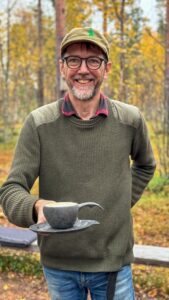
Steffan Wunderink from HaliPuu is also a 'campfire barista'.
Now, during ruska, he brews his coffee on a campfire in the middle of the forest and whisks his milk with an old frying spoon, just like his grandmother used to. "It makes the most beautiful froth." After a tree-hugging session and half an hour of swaying in a hammock, we sit around the fire and drink the most delicious chai latte ever. "The forest reduces your stress and makes you feel more connected to nature," says Riitta. We do indeed feel different. Lighter. More cheerful.
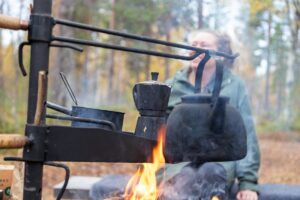
Steffan makes his coffee over a campfire, in the middle of the forests of Levi, Finland.
Ruska and Aurora come together
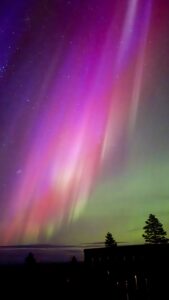
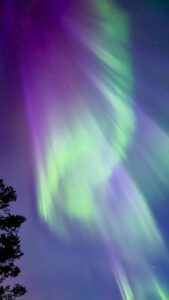
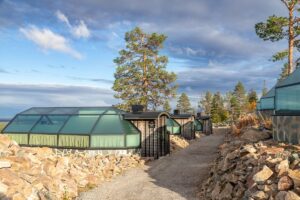
With a big smile, we drive back to "our" igloo* where we'll spend the night. Time for the grand finale. This time, we're in luck. The dark sky treats us to a phenomenal light show, with every color of the rainbow flashing through our eyes. First left, then right, then directly above us. Slow-motion fireworks without a sound. The Northern Lights, the aurora borealis. A slow-motion explosion of color. That, too, is ruska.
* Curious where we stayed? Read here why sleeping in this igloo is a challenge.
Things to do during ruska – Tips!
During ruska – that is, in autumn – you can do activities in Finnish Lapland that are more difficult in winter, because there can be metres of snow and the rivers and lakes are frozen.
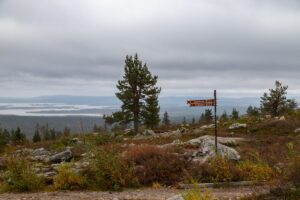
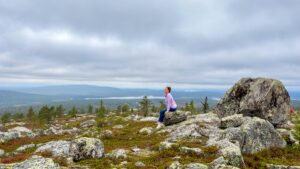
- Hiking to Särkitunturi in Pallas Yllästunturi National Park – an unearthly beautiful landscape through forests and barren plateaus. Along the way, you can warm up in a campfire hut where the fire burns and locals roast their sausages and rolls.
- Aurora floating with Safarartica in the dark in a flotation suit on an infinitely deep lake while above you the starry sky shines and with a bit of luck the aurora borealis (the Northern Lights) shows itself.
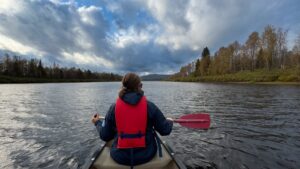
- Canoeing on the longest river in Finnish Lapland: the Ounasjoki. If you go with a guide from Polar Star Travel, you'll stop halfway on a sandbank, where a campfire will be lit to roast sausages or marshmallows.
- For art and culture lovers, a visit to Arktikum in Rovaniemi is a must. Here you can discover everything about Finnish history and Sami culture. In Kittilä, you'll find the Särestöniemi Museum, a tribute to one of Finland's most important painters, Reidar Särestöniemi.
READING TIP
The program southern Finland is also worth a visit!
[…] the ruska in Finnish […]
[…] and overlooks the landscape. We were there in autumn (the "ruska" season, be sure to read the article about this special season), but this is also a dazzling location in winter, see […]