

Wadi El Gemal – tips & tricks
Wadi el Gemal National Park is located on the Red Sea in Egypt, 45 kilometers south of Marsa Alam. The park consists of sea (approximately 2.000 km²) and land (almost 2 km²), with a coastline of approximately 5.000 kilometers. Several offshore islands are also part of the park, to which access is only permitted with a ticket and a guide. Below you can read more information and I share tips and tricks.
The origin of the Wadi El Gemal
Wadi El Gemal literally means "Valley of the Camels." The wadi (Arabic for valley) lies in the delta of an ancient river that flowed from the mountains into the Red Sea 15.000 years ago. The delta was fertile and green and was renowned for its emeralds. Even Cleopatra and the pharaohs wore emerald jewelry from this valley. A major trade route once ran through the area, with the ancient seaport of Berenike on the Red Sea – south of the wadi – serving as a major transit point.

The landscape of Wadi El Gemal. Photo: Gianni Bodoni
Flora and fauna in Wadi El Gemal

Wadi El Gemal National Park is largely covered by the sea. Photo: Gianni Bodoni
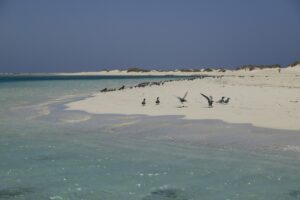
The island is uninhabited and a paradise for birds.
Although the river and its tributaries dried up centuries ago, it is still home to 140 species of plants and shrubs, 45 species of birds, 25 species of reptiles, and 24 species of mammals. Add to that the unique coral reefs, the mangrove forests, and the marine life—more than 100 different fish, manatees, sharks, dolphins, and sea turtles—and you can understand why this fragile and biodiverse region was declared a National Park in 2003. The park is home to some 300 Ababda families. A partnership between these Bedouins, the adjacent Gorgonia Beach Resort, and the National Park, governments, private sector and local NGOs promote sustainable and responsible tourism in Wadi el Gemal.

Wadi El Gemal, where the sea and desert meet. Photo: Gianni Bodoni
How do you get there?
You fly from Amsterdam to Marsa Alam Airport, which is about an hour and a half's drive from the national park.
Transport on site
It's not recommended to explore the national park on your own. There are no signs, and the risk of getting lost is high. Because there's no cell phone reception, you can't sound the alarm if necessary. Renting a car is difficult, and public transport is minimal. If you do decide to go on your own, be sure to rent a reliable 4x4, as there are no roads in the desert. Keep in mind that you'll encounter several checkpoints on your way to the desert. The officers only speak Arabic. It's easier to arrange day trips from your hotel or resort; they often offer excursions, e-bike tours, and jeep safaris. Guides, escorts, and drivers are often Ababda, who know the desert like the back of their hand (and speak Arabic and English). While less exciting, the adventure is just as great.
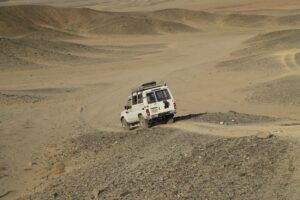
A jeep safari through Wadi El Gemal.
Visa
To visit Egypt you need a visa. You can apply for this online via the official websiteYou can also purchase a tourist visa upon arrival at the airport. A visa costs $25. Before your trip, check the most up-to-date information and security situation in Egypt at Netherlands Worldwide.
Stay in Wadi El Gemal
During my visit to Egypt I stayed in the Gorgonia Beach ResortThis hotel is located right on the Red Sea and just a stone's throw from Wadi el Gemal National Park. It is a Green Star Hotel, the sustainability certification for hotels in Egypt. The all-inclusive resort, with 350 rooms, is not very large, but it is spaciously designed with plenty of greenery, a long sandy beach, various bars, restaurants, and shops, and a large swimming pool. It is situated in an area that is not (yet) overrun by mass tourism.
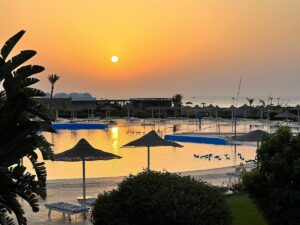
Sunrise at Gorgonia Beach Resort.
A large coral reef lies directly off the coast of the resort, where you can snorkel and/or dive from the beach or the resort's pier. From Gorgonia, named after a red coral found in the Red Sea, excursions are offered to various locations in the national park: from jeep safaris, e-biking, and hiking through the desert to snorkeling or diving at one of the offshore islands. Members of the Ababda often lead the excursions and activities.
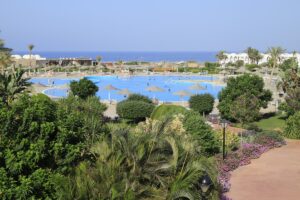
Gorgonia Beach Resort.
Note: In order to benefit from daylight longer – the sun sets around 18.00:18.30-XNUMX:XNUMX PM – Gorgonia uses its own time compared to the Egyptian and Dutch ones: the clock is put forward one hour.

The beach at Gorgonia Beach on the Red Sea.
Things to do in Wadi El Gemal
Island Wadi el Gemal This uninhabited island off the coast of Wadi el Gemal is part of the national park and a protected nature reserve. Numerous bird and crab species live among the mangrove forests and low dunes, and green sea turtles lay their eggs here. Access to this island is only possible with a national park guide; a trip can be booked through Gorgonia Beach Resort. The boat trip includes several stops for snorkeling among the coral reefs. Guide Islam El Sadek is a marine biologist and knows all about the flora and fauna on and around the island.

In the distance lies the island photo (c) Gianni Bodoni
Sikait In the heart of the desert, between two mountain ranges, lies the ancient Roman settlement of Senskis, now called Sikait. Emeralds were once mined here. Remains of houses and two temples remain. Sikait is a two- to three-hour drive from the main road and can be visited on a jeep safari. You'll pass through a diverse desert landscape, with ancient coral reefs, basalt mountains, and plains of acacia and toothbrush trees. Bedouins brush their teeth with sprigs of this arak (salvadora persica).

Bedouin at the ancient Roman temple in Sikait.
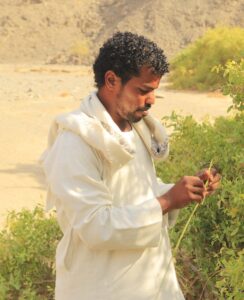
Bedouin at the toothbrush tree – they clean their teeth with the twigs.
Qulaan A small Bedouin village, idyllically situated in a bay fringed with mangroves and millions of years old coral reefs. The Ababda who live here provide simple meals and perform the traditional coffee ceremony al-jabanah. There's a natural pool in the bay where you can cool off.

Bedouin coffee ceremony.
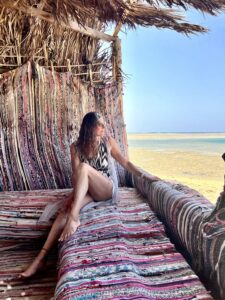
Enjoy this special place in Wadi El Gemal.
No taking along allowed
Along the coast, on the islands, in the desert, and in the mountains of Wadi el Gemal, fossils, pieces of coral, and the most beautiful shells are literally there for the taking. You can pick them up, but you can't take them with you. At the Egyptian airport, you and your luggage will be subject to strict security checks. If you are caught, you will receive a fine and have your passport marked. You must also declare where you took the shell/fossil/coral. The authorities will then ensure that the object is returned to its place of origin.
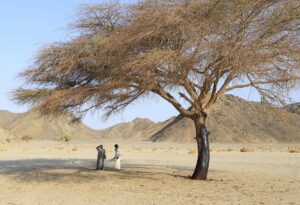
Bedouins under an acacia tree.

Dromedaries in Wadi El Gemal. Photo: Gianni Bodoni
READING TIP
With guide Ahmedani we made some beautiful trips through Wadi El Gemal. In this article Read about our experiences and get to know contemporary Bedouin life.

Guide Ahmedani
[…] have more information and tips & tricks at a glance […]